Wednesday, June 15, 2011
Phenology
Warm, dry. Highs in the upper 60's with lows in the low 50's. First wildfire of the season on the Gunflint Trail. As of now the Forest Service will simply monitor this small 6 acre fire in the Boundary Waters Canoe Area Wilderness. The fire is on Gaskin Lake which about 25 miles to the northeast from the homestead. A bear tore down our bird feeder. Spotted a firefly in the air last night. Fireflies are winged beetles that produce light from their abdomen through a chemical reaction called bioluminescense in order to attract a mate.


Saturday, June 11, 2011
Going underground...
Anticipation is running high. If the nerves are going to get you at any point in a project such as ours it's now. As I write there is a 2-3 foot deep trench running down the length of our property. The trench will be home to the strand of wire that will soon conduct the flow of electrons to our lights and refrigerator; bringing us the luxury of modern appliances that I have taken for granted (until now).

With the help of a friend we dug the trench in the course of a long June summer evening. Minnesota code mandates that the conduit-clad wire must be no less than 24 inches deep. Anything less requires a layer of concrete over it for protection. This means more material which means more money so we dug as deep as we could. The digging, however, was better than I had anticipated. We hit bedrock at most of the predictable spots, but for the most part we dug through 6-9 inches of black silty clay loam, iron red clay loam and red porphyritic rhyolite.

I have assembled the materials from which we will wire the whole mess together and some day very soon flip a switch. Then we will be able to read under something other than a candle or oil lamp! In the shot above you can see the spool of conduit and transformer in the background. In the foreground is the socket meter (in the box) and the 4-wire aluminum direct burial service entry cable under the tarp.

A view from the transformer looking at "the castle". Notice the bobcat parked behind the truck. This piece of equipment did the real work. Also note the trailer. The trailer houses a blower that we used to blow cellulose insulation into the attic. This worked very well. One person kept the blower full of material as the other handled the hose and deposited a uniform blanket atop the ceiling.

The spool of conduit and transformer.
Meanwhile inside the humble abode:

With the walls and ceilings all painted we finally unwrapped the appliances and started to get the kitchen situated.

It's starting to come together. Since the attic is insulated we have begun to move storage items out to the property and are beginning to switch gears into "move mode". Now let's just hope the underground work goes as planned...
Phenology
Gorgeous summer day on the North Shore. Highs in the upper 60's/low 70's with lows in the low 50's. A black bear tore down the bird feeder last night. The first hatch of black flies and mosquitos as come and gone (awaiting the next round). The summer flora is in full bloom.
Friday, June 3, 2011
Phenology
Stormy. Small, swift bands of uncommonly intense storms have swept over the North Shore in the past few days. A tornado was spotted just 60 miles away down the shore! Streams are still running high as a result of the rain. Highs in the upper 60's and lows in the low 50's. Blue bells and columbine have taken to flower. Wild strawberry has sprouted along the road.
Tuesday, May 31, 2011
Insulation & Drywall
Now that the cabin is wired it is time to finish out the walls and start thinking of really making this place home. Although I ended up really enjoying wiring I was eager to get back into projects that I am a little more familiar with.
In northern Minnesota, a well insulated home is absolutely crucial to a comfortable winter. The day we passed our rough in electrical inspection I hit the ground running and was able to get all of the exterior walls insulated.


Before we could drywall the ceiling, I needed to build the storage platform in the rafters. I first framed cross members atop the trusses to build the platform on. From there we heaved sheets up and placed them down the center of the entire structure. We now have almost 400 square feet of storage!
Notice the black pieces along the walls. Those are plastic sheets that allow air to flow from the soffit vent up towards the vent that runs along the ridge. They prevent the blown-in insulation from clogging the vents.

A plastic vapor barrier is then stapled tight on the ceiling and walls before the drywall is installed. Once the vapor barrier is "tacked in", the first step in drywalling is to lift the ceiling panels. These 5/8" thick sheets made of gypsum (a soft mineral) are 4x8 feet. Needless to say they are quite heavy. To lift them I enlisted the tallest, strongest friends that I have. Without a mechanized panel lifter, the easiest way to hoist these sheets 8 feet in the air is to build two "T's" out of 2x4 lumber. Two people each take a "T" and lift the sheet on either end while the third person fastens the drywall screws into the joist with a screw gun and counter sink bit. The counter sink bit drives the screw into the sheet so that you can put a layer of mud over it to make it flat.

Measuring out receptacle boxes and windows take time. You have to be very precise. The last thing you want is to cut a hole in the wrong location! In the end, I only screwed up one cut. The good news is that it happened in the beginning so I was able to use the sheet for other smaller "scrap" pieces.

Once the ceiling is complete (24 sheets), we then moved on to the walls (47 sheets). The walls are thinner (1/2" thick) and made of lighter material so they are much easier to work with. The ceilings must be thicker in order to prevent the sheets from sagging under the relentless force of gravity over time.

Amy's dad, Bill, gave us a hand for a few days. We quickly "got in synch" and were able to finish out the walls in just one and a half days of work!

The next step is to tape and mud the joints between the sheets. While lifting the panels is very physically demanding, mudding is mentally trying. First you put a thick layer of mud over the joints. You then put wet drywall tape over the joint followed by another layer of joint compound. The idea is to meld the junction of the two sheets into one continuously smooth wall surface. Any irregularities in the mud must be sanded down and followed by another layer of compound until the surface is smooth. This kind of tedium can drive folks crazy! Me, I kind of like it. You just zone out and make it look pretty.
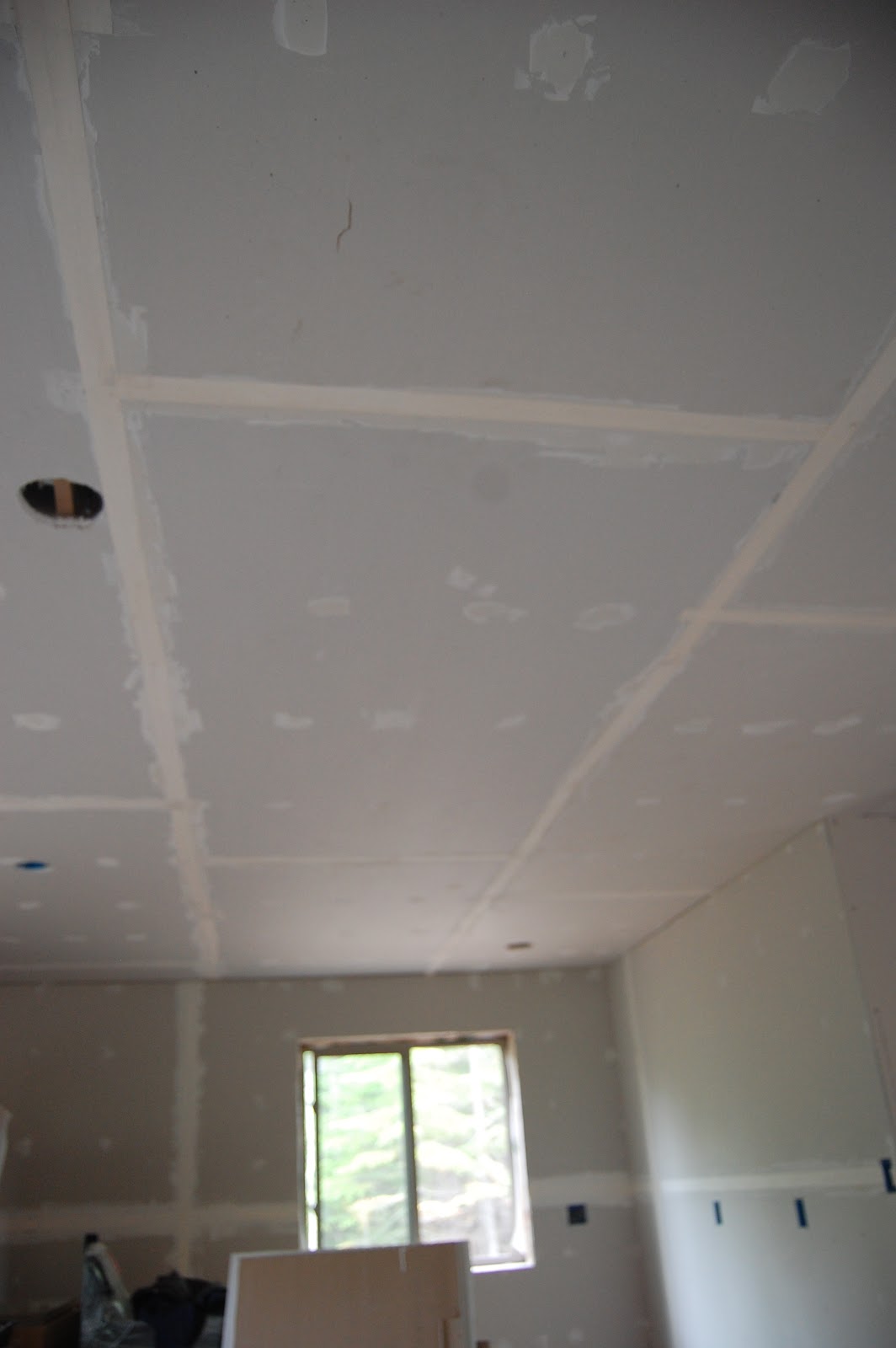
Fully taped and awaiting another layer of mud.

Our place, fully "rocked"! It's amazing what a difference it makes...
The other day while at the store we found ourselves with the rest of the crowd in the paint aisle. While I kind of missed the relatively empty lumber yard, there was a great sense of satisfaction to be at this stage...
Friday, May 20, 2011
Phenology
Warm. Highs in the mid 60's with lows in the high 40's. Spring flowers spotted today: Lady fern fiddleheads, large leaf aster leaves, miniature burgundy sarsaparilla, wood anemone blossoms and nodding trillium buds. Marsh marigolds and wild strawberry flowers are abound. Bugs are in the air.
Tuesday, May 17, 2011
Phenology
Clear skies and sunny. highs in the low 60's and lows in the upper 40's. The walleye season opened last week. Caught two 10-12 inchers. Spotted a black bear crossing the highway south of Duluth. First leaves have sprouted from poplar trees. Despite the grasses "greening up", the forests are drying up quickly. Fire danger "high" on the Gunflint Trail.
Wednesday, May 11, 2011
Phenology
Highs in the upper 50's and lows in the mid 40's. Low pressure has dominated weather patterns for the last week or so with frequent light spring rains. Ice is out on the lakes of the Gunflint Trail. Spotted two moose feeding on submerged vegetation in ponds. The hare are now completely brown for the summer.
Monday, May 9, 2011
"Yard" Projects
While we are making great progress inside finishing out the cabin there still is plenty going on outside as well. We try to do at least one chore outside at the end of the day when it is too dark to work inside without light.

The south side of the cabin stares south down the driveway to Lake Superior. We thought that this would be a great location for a fieldstone patio. Here you can see the local rock landscaping and the sand that we have tampered down in preparation for the 2 inch thick fieldstone that we are collecting from the property to set and complete the surface.

We have rock "issues". This outcrop is preventing the water from our "castle moot" to flow down the ditch. However, like any geologist I know exactly what to do about that! Here I am with my drill hammer and rock chisel banging away along the fracture sets of the rhyolite trying to cut a channel for the water to escape. It's not the most glamorous job in the world but actually kind of fun if your a "rock-licking geologist".

This picture pretty much sums up spring on the North Shore. We're prepping soil to plant our seedlings next to the churning wood stove.

Planting seeds in trays. Once they have sprouted we'll put the plants in the cold frames to grow and harden off before being planted outside.
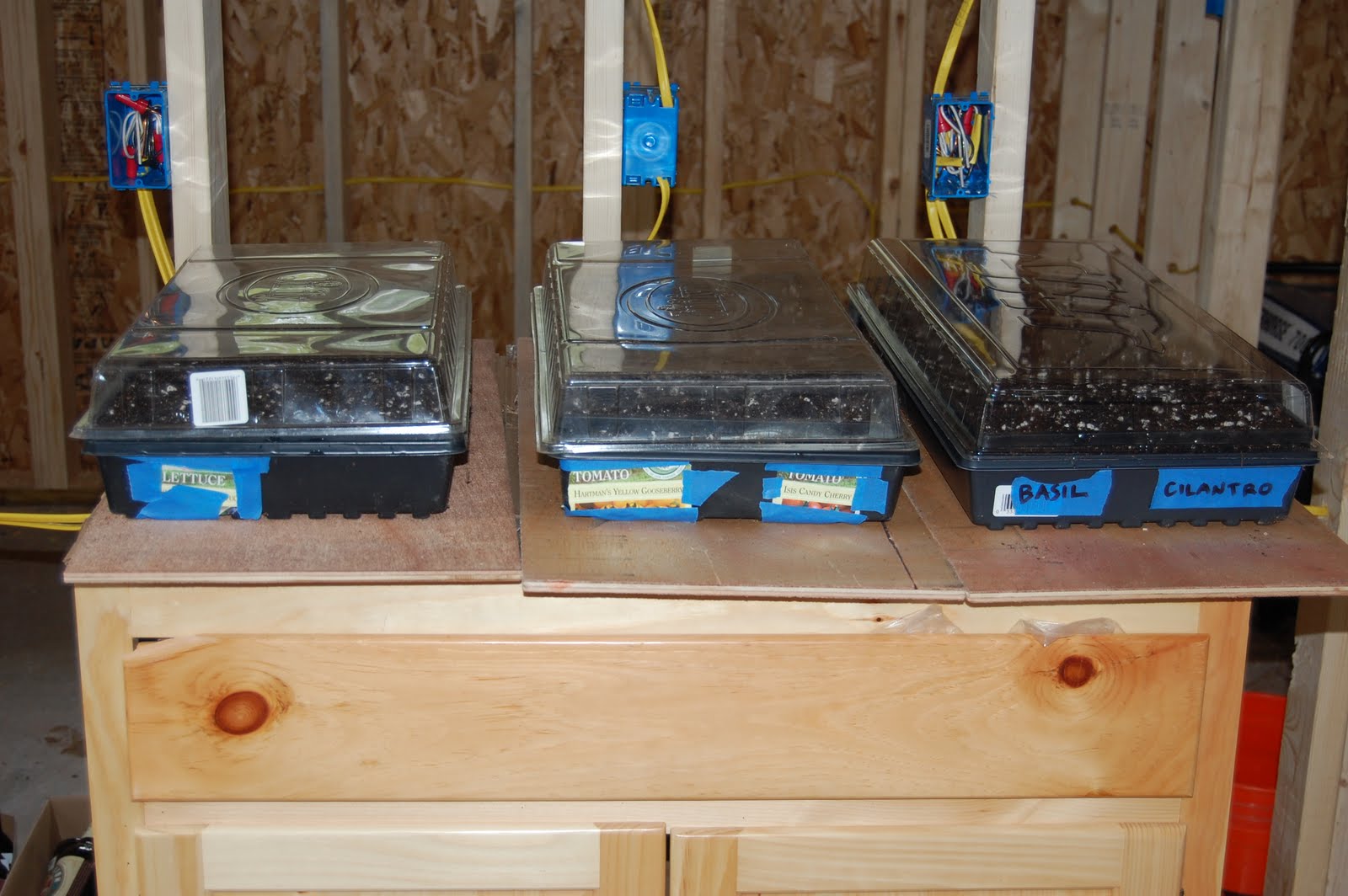
Three trays all planted and ready to sprout.

We built cold frames out of old windows and lumber scraps. Cold frames are a great way to extend our short growing season as they create a microclimate for not only sensitive seedlings but full grown lettuce and spinach.
Beyond these projects we have roofed our shed and cleared a spot for our winter firewood supply that will be delivered in 8 foot lengths in June. One of the best things about developing a property from scratch is that it truly is a "blank slate". There are so many things to do on a daily basis that you never get bored of doing the same thing (except maybe for cutting down balsam fir).
Friday, May 6, 2011
Phenology
After a few days of a gentle spring rain the sun is slowly showing itself. Highs in the mid 50's and lows in the upper 30's. First bugs out for the season. Lettuce has sprouted in the cold frame. First ticks on the dog. The snowshoe hare has almost entirely lost it's white coat and is now about 75% brown.
Subscribe to:
Posts (Atom)